
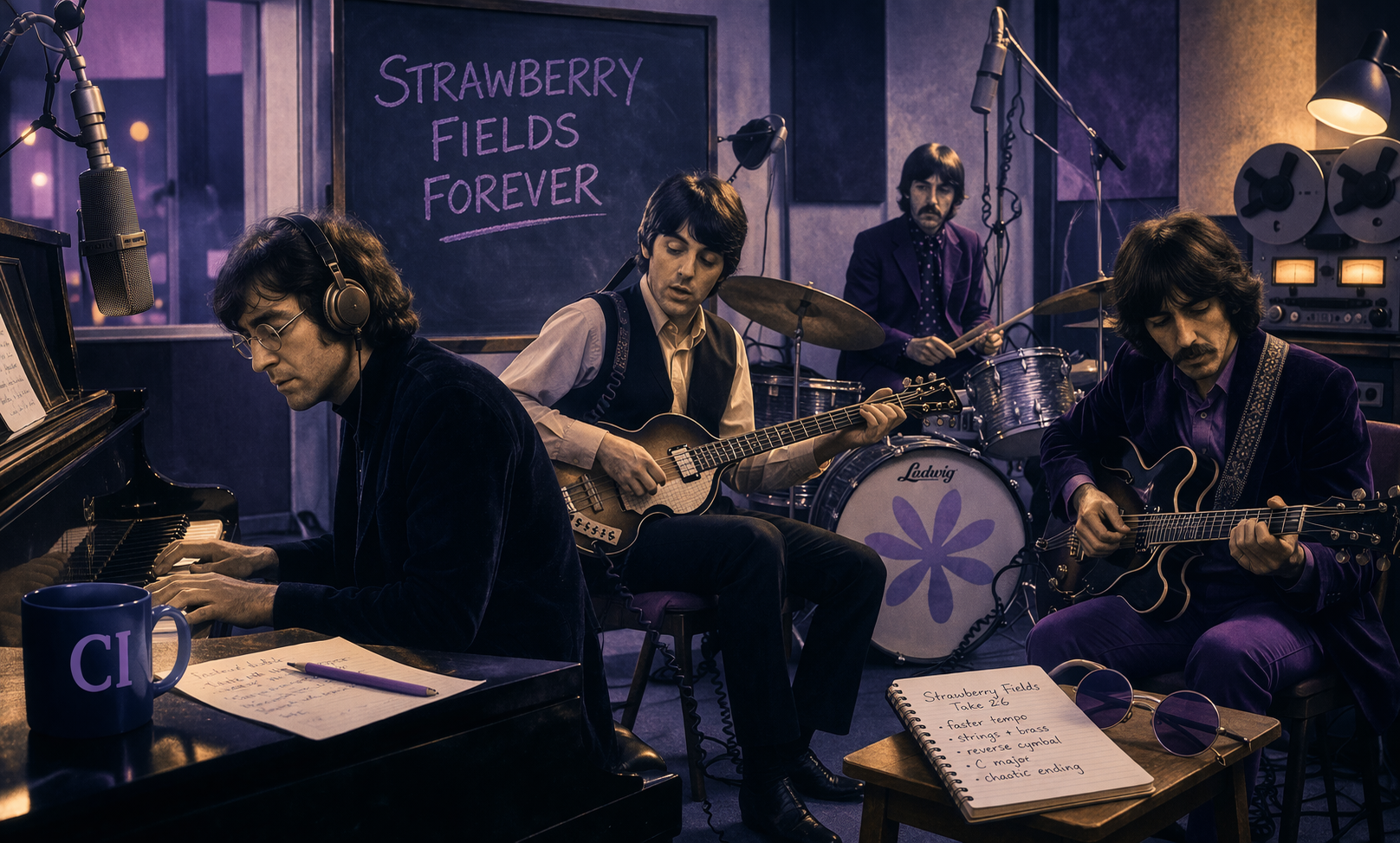
The Space Where Creativity Happens
What the Beatles understood about leadership that most organisations still miss
In late 1966, the Beatles walked into Abbey Road Studios with a new song John Lennon had written called Strawberry Fields Forever.
They recorded it.
Finished it.
Then rejected it.
They recorded another version.
Finished that too.
Then decided they preferred parts of the first version after all.
So they asked their producer, George Martin, to combine two recordings in different keys and different tempos into a single piece of music.
He didn’t say it couldn’t be done.
He said: let’s try.
let’s try.
A month later, they released something the world had never heard before.
Most people see this story as evidence of musical genius.
I see it as evidence of something else:
a perfectly constructed creative environment.
Creativity did not appear because the Beatles were extraordinary individuals.
It appeared because they were working inside the right space.
And this is what leaders misunderstand most about creativity today.
Creativity is not a personality trait.
It is an environment.
Creativity is not produced by pressure
When the Beatles stopped touring in 1966, something important changed.
They removed a constraint that no longer mattered.
Without the expectation that songs had to be performed live, they could suddenly make music that only needed to exist in the studio. That single decision opened an entirely new creative frontier.
This is one of the central responsibilities of leadership:
not adding pressure
but removing unnecessary constraints.
Creative teams don’t need more urgency.
They need more possibility.
Creativity begins in memory, not strategy
Strawberry Fields Forever began as a reflection on John Lennon’s childhood.
Not a brief.
Not a workshop output.
Not a structured planning session.
It began with meaning.
Original ideas rarely start as solutions. They start as questions. Or memories. Or fragments of identity that haven’t yet found their form.
Leaders often try to accelerate teams straight into execution.
But creativity begins earlier than that.
It begins in reflection.
Distance improves thinking
John started writing the song while away from the rest of the band.
That distance mattered.
Solitude allows ideas to become complex before they become collaborative.
In organisations, we often confuse constant interaction with progress. But uninterrupted time is not a luxury in creative work.
It is a requirement.
Leaders create creativity by protecting thinking space.
Early versions are supposed to be unclear
The first recording session didn’t produce the final structure of the song.
It produced direction.
The band could hear they were heading somewhere important. They just didn’t yet know where.
Most teams panic at this stage.
They mistake uncertainty for failure.
Creative work always sounds wrong before it sounds right.
The role of leadership is not to eliminate uncertainty.
It is to stabilise people inside it.
The most creative teams know when to stop working and start thinking
Instead of recording take after take, the Beatles paused and returned to the arrangement.
They stepped out of execution mode and back into design mode.
This is rare in organisations.
Most teams keep moving forward even when the structure underneath the work isn’t ready yet.
Creative progress is not linear.
It moves between reflection and action.
Leaders must protect both.
Psychological safety makes experimentation possible
After completing what should have been the final version of the track, John Lennon returned and said:
“I don’t like it.”
No defensiveness followed.
No sunk-cost argument.
No attempt to justify the work already done.
They simply started again.
This is what psychological safety looks like in practice.
It is not comfort.
It is permission to say the work is not finished yet.
Great creative leadership supports impossible requests
John asked George Martin to combine two recordings in different keys and tempos.
Technically, this should not have worked.
Martin did not dismiss the request.
He explored it.
Creative leaders translate intuition into possibility.
They don’t close doors too early.
Constraints don’t prevent creativity. They focus it.
The Beatles were working with only four recording tracks.
Most bands saw this as a limitation.
They treated it as an opportunity.
Constraints become creative fuel when teams are encouraged to experiment instead of optimise.
Innovation doesn’t come from unlimited resources.
It comes from intelligent boundaries.
Earlier versions are not mistakes
Instead of discarding the earlier recording entirely, the Beatles reused it.
Iteration accumulated value.
Creative organisations don’t throw ideas away.
They transform them.
Creativity requires faith in the process
At multiple points during the recording of Strawberry Fields Forever, the outcome was unclear.
They didn’t know how the pieces would fit together.
They didn’t know what the final sound would be.
They didn’t know whether the experiment would succeed.
They kept working anyway.
This is the part of creativity that is hardest to teach.
Not technique.
Not brainstorming.
Not innovation frameworks.
Faith.
Creative teams move forward before certainty appears.
Leadership exists to make that movement possible.
The leader’s real role is to create the space
In theatre, a director does not tell actors how to say every line.
They create the conditions in which performance can emerge.
Creative leadership works the same way.
The Beatles succeeded not because someone controlled the outcome, but because someone held the space where discovery could happen.
That space included:
time away from pressure
permission to experiment
freedom to reject finished work
trust between collaborators
technical support without control
and belief that something new was possible even before anyone knew what it was
This is the environment where creativity lives.
Not inside individuals.
Inside relationships.
Inside process. Inside space. And creating that space is the real work of leadership.
Leave a Reply